
How to Get Employees to Actually Use AI
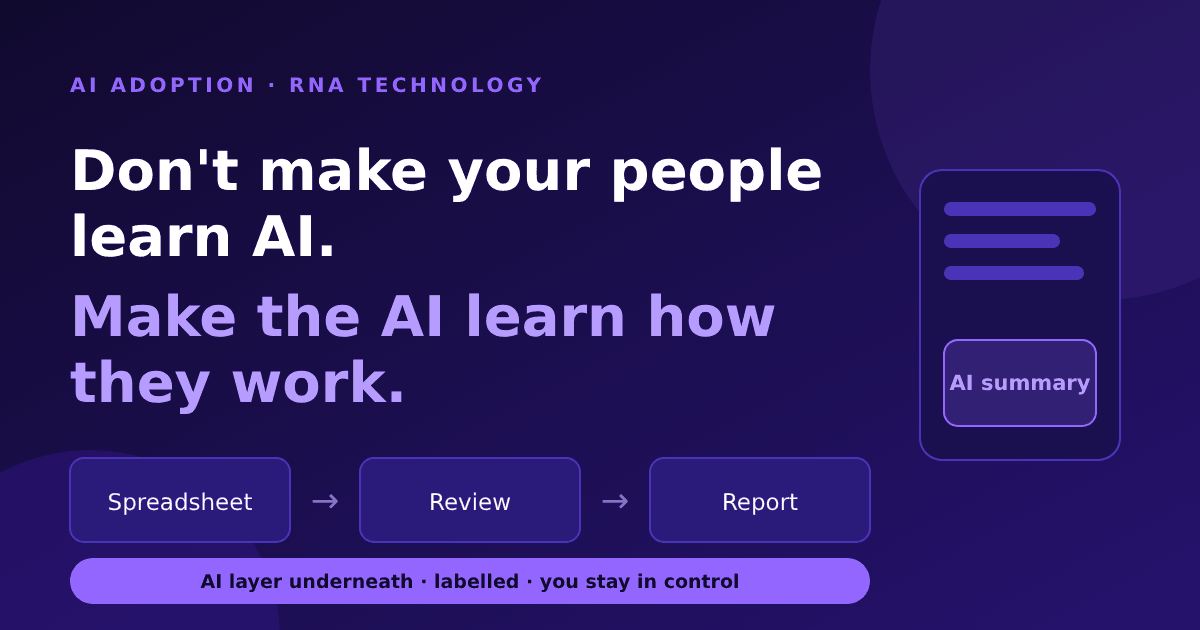
Most AI projects do not fail because the model is bad. They fail because the tool asks people to change how they work, and people already have a full day.
At RNA Technology, we build AI automation for companies across Singapore and Southeast Asia. Our approach to AI adoption is simple: make the AI fit the team, not the team fit the AI. This article explains what that looks like in practice, why we think it works, and what it costs.
Why employees ignore enterprise AI tools
Picture a purchasing officer who checks product specifications on Google hundreds of times a day. Many of those searches now return an AI Overview at the top of the page, generated by a Gemini model that Google customised for Search. The officer gets answers faster and was never asked to attend a workshop, learn prompts or change a habit.
The box is clearly labelled “AI Overview”. It sits inside something the person already does. That is the pattern we try to copy.
Enterprise AI platforms often go the other way. They are built to serve many teams at once, so each team gets features that do not apply to it. They ship with impressive capabilities that almost nobody opens. For employees further down the process, who usually carry the heaviest workload, a new tool can become one more burden.
The data on AI adoption at work points the same way. BCG’s AI at Work 2026 survey of nearly 12,000 respondents found that 74% of frontline employees now use AI every day or a few times a week. Yet 41% of all respondents report increased mental strain from using it, and 41% say it has increased the time they spend making decisions. Usage is rising, but usage alone is not the same as AI helping.
The alternative: small, custom AI tools built around the workflow
Instead of one large platform, we build small AI tools designed for one team and one job. Our process has three parts.
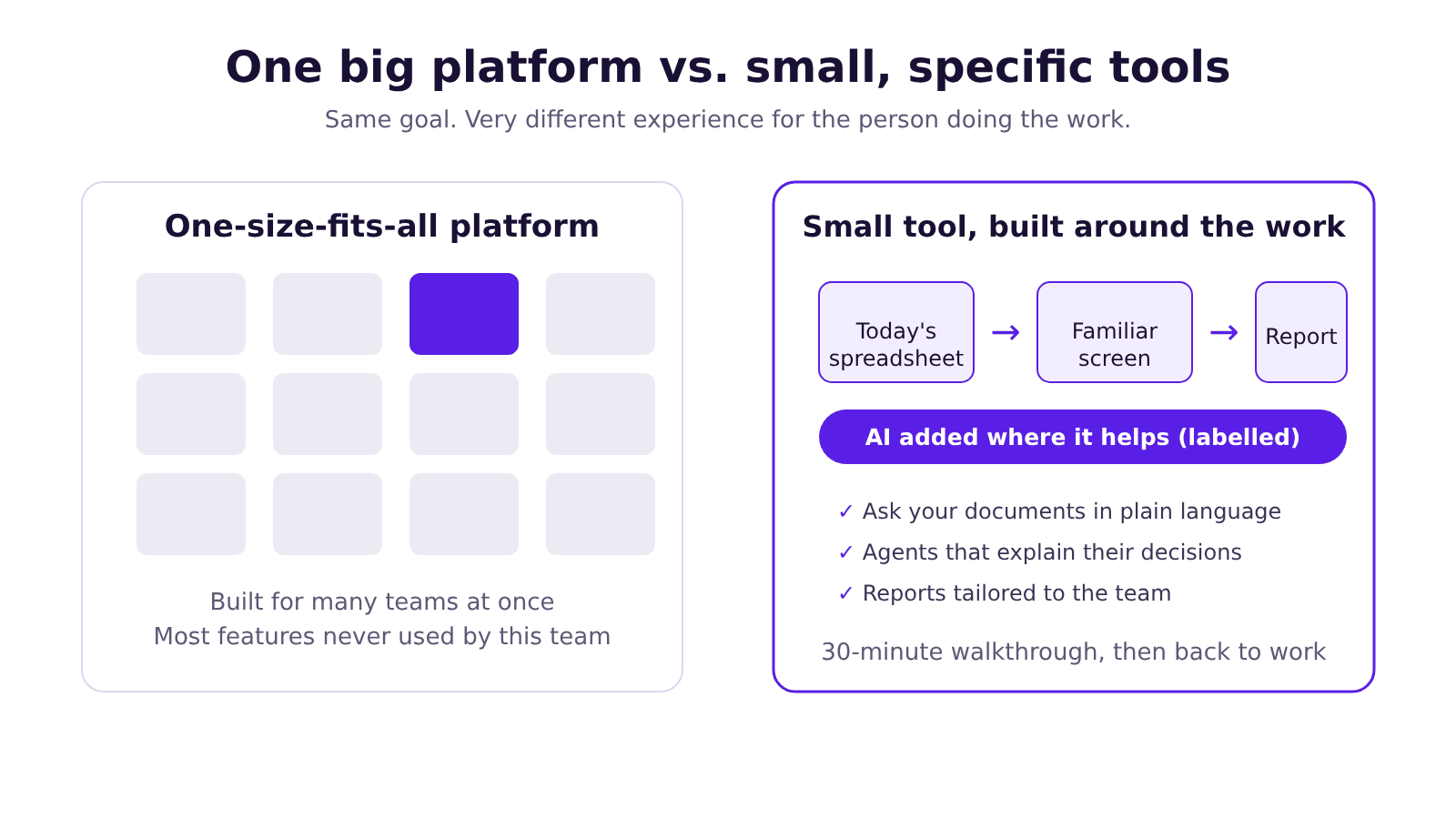
1. Study the work before building anything. We shadow the team through several iterations and map their workflows. Then we identify which steps can be automated and which cannot be disrupted. This is also how our embedded engineering engagements start, with an engineer sitting inside the team rather than reading a requirements document.
2. Start from what people already use. We look at the spreadsheets, legacy system interfaces, apps and dashboards the team relies on today, and build around them. In more complex projects we merge several functions into one simpler process. That improves the process itself and also lowers operating costs.
3. Add capabilities people did not know they needed. Once the tool fits the daily routine, we layer in features such as:
- querying documents and databases in plain language, using retrieval-augmented generation (RAG)
- AI agents that automate decisions and explain the reasoning behind them
- report generation tailored to each team’s requirements
Redesigning work behind the scenes while keeping the interface familiar is consistent with what the research shows. McKinsey’s State of AI 2026 survey (1,719 respondents across 97 countries) found that nearly three-quarters of AI high performers have fundamentally redesigned workflows because of their AI use, compared with one-quarter of other respondents. High performers, defined as those attributing 5% or more of EBIT to AI and describing its impact as significant, are just 6% of respondents. The redesign matters. It just does not have to be something the end user has to relearn.
Do you still need training? Yes, a little
“No training” would make a catchy headline, but it is not what we do. Every tool we deliver comes with a user guide and a walkthrough of 30 minutes at most.
The goal is that people can use the tool immediately, without disrupting their day-to-day work. We package each solution into an interface that is easy to navigate and easy to control.
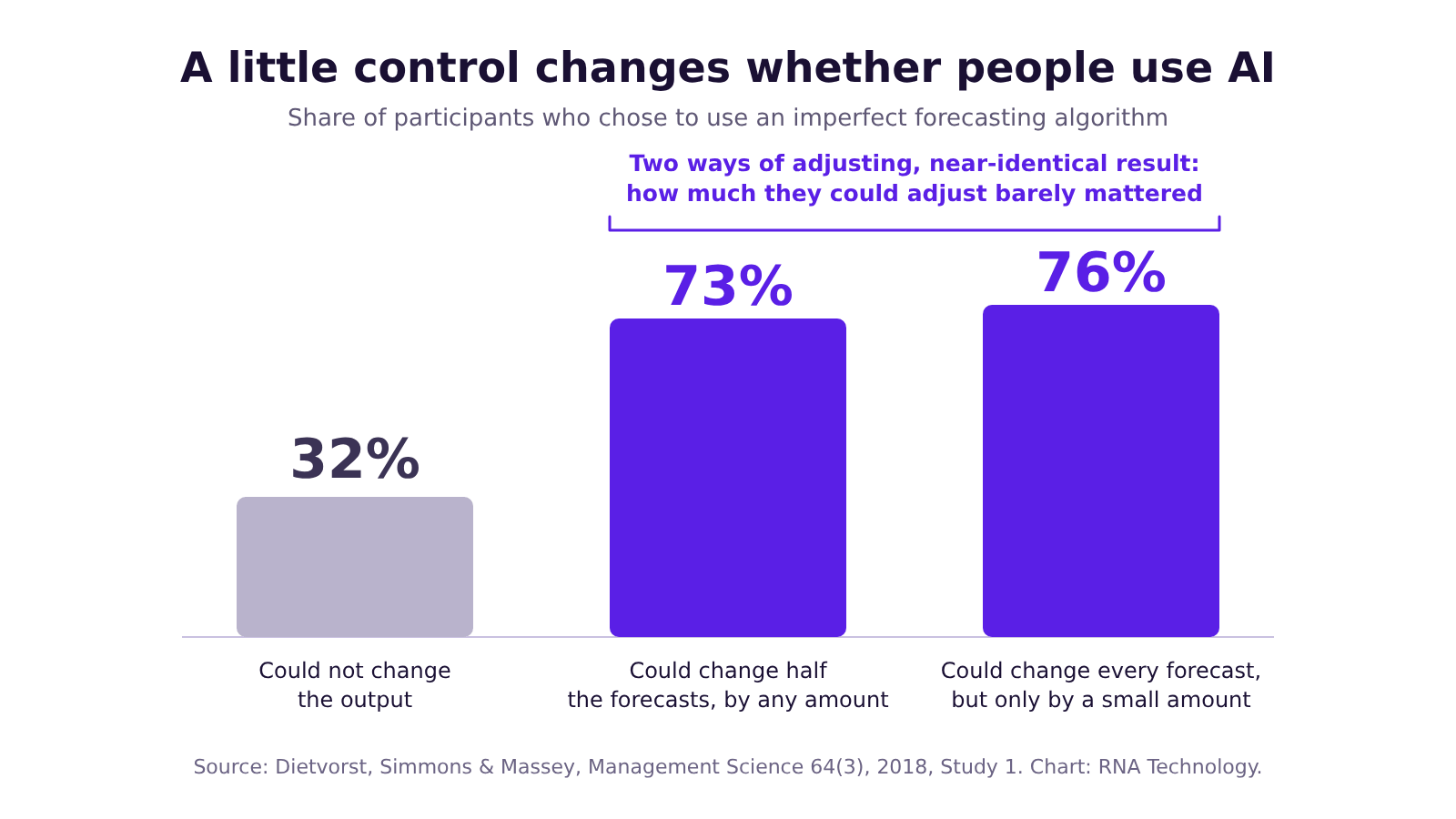
Control matters for adoption. In a study published in Management Science, only 32% of participants chose to use an imperfect forecasting algorithm when they could not change its output. When they could adjust it, even slightly, that rose to 73–76%. How much they could adjust barely mattered. The practical lesson for AI tool design: let the AI suggest, and let the person make the final call.
Quiet does not mean hidden: label what the AI does
AI that fits into existing work should be low-friction, not invisible. Anything AI-generated in our tools is labelled as AI-generated, and users can review and override it.
This also aligns with Singapore’s regulatory direction. The IMDA’s Model AI Governance Framework for Agentic AI (January 2026) tells organisations to declare upfront that users are interacting with agents. If people cannot tell which answer came from a model, they cannot decide how much to check it. Where the stakes are higher, we red-team and audit the system before it reaches customers.
What AI adoption looks like in Southeast Asia
In Southeast Asia, we almost always find manual, non-digital processes, especially at the lowest level of an operation. Sometimes a process is so complex that doing it manually is genuinely faster. But accountability and monitoring still need a structured digital system.
That is where small, custom AI tools help. They connect the enterprise-grade system at the top with the manual reality on the ground, without forcing teams to abandon methods that work. We see this pattern across most of the industries we work in, from logistics and manufacturing to professional services.
The trade-offs of this approach
We are upfront about what it costs:
- Discovery takes longer.
- Requirements often change mid-development.
- Timelines can stretch.
We include a free three-month warranty, so feedback and issues are fixed at no charge. In our projects, adoption usually starts to pick up three to ten working days after deployment, which is when most feedback arrives. Over the next one to two months, feedback tapers off, which tells us the solution is settled and working for the business.
We think it is better to invest more at the start and run smoothly afterwards than to ship fast and leave the team putting out fires every day.
Key takeaways
- Employees skip AI tools that add effort to an already full workload.
- Small, team-specific tools tend to be adopted more easily than one-size-fits-all platforms.
- Short training (30 minutes) plus an interface people can control is enough to start.
- Label AI outputs and keep a human in control.
- Spend more time on discovery so the tool fits how work actually happens.
Don’t make your people learn AI. Make the AI learn how your people work.
Frequently asked questions
Why do employees not adopt AI tools?
Common reasons include tools that do not fit existing workflows, features irrelevant to a team’s job, and the extra mental load of learning something new on top of a full workload.
How long does it take for a team to adopt a custom AI tool?
In RNA Technology projects, adoption typically starts three to ten working days after deployment, with feedback tapering off over one to two months. Results vary by project.
Does custom AI automation need staff training?
A little. We provide a user guide and a walkthrough of up to 30 minutes so people can start immediately.
Can RNA Technology build AI tools for our existing systems and spreadsheets?
Yes. We map the tools your team already uses, including spreadsheets, legacy systems and dashboards, and build around them. See our AI automation service for how those projects run.
Talk to RNA Technology
RNA Technology is an AI automation and cloud consultancy serving businesses in Singapore, Indonesia and across Southeast Asia. If your team has an AI tool nobody uses, or a process you want to automate without disrupting it, book a free 30-minute consultation or send us a message.
Sources
- AI at Work: Why Strategy Matters More Than Tools — BCG, 3 June 2026 — bcg.com
- The state of AI in 2026: On the road to ROI — McKinsey, 25 August 2026 — mckinsey.com
- Overcoming Algorithm Aversion: People Will Use Imperfect Algorithms If They Can (Even Slightly) Modify Them — Dietvorst, Simmons & Massey, Management Science 64(3), March 2018, pp. 1155–1170 — wharton.upenn.edu
- Model AI Governance Framework for Agentic AI, Version 1.0 — IMDA Singapore, 22 January 2026 — imda.gov.sg
- Generative AI in Search — Elizabeth Reid, Google, 14 May 2024 — blog.google (product fact only)